Federated learning / Concept drift
When data changes, how should federated learning adapt?
A visual guide to helping distributed models keep up with changing data.
Data changes. Models become stale. Our MASTER-FL framework helps distributed learning systems detect change and decide when to restart—without knowing future shifts in advance.
01 / The problem
Devices can learn a shared model without pooling their raw data. But when new classes appear or labels change, yesterday’s model may no longer fit today’s task. Simply continuing the same training run can miss that change.
02 / The idea
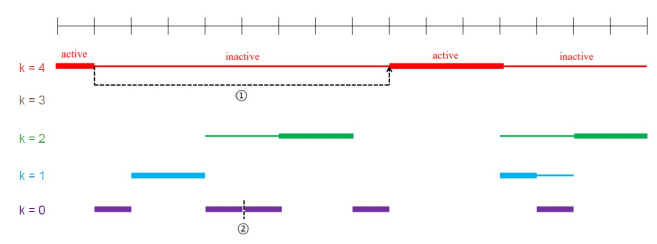
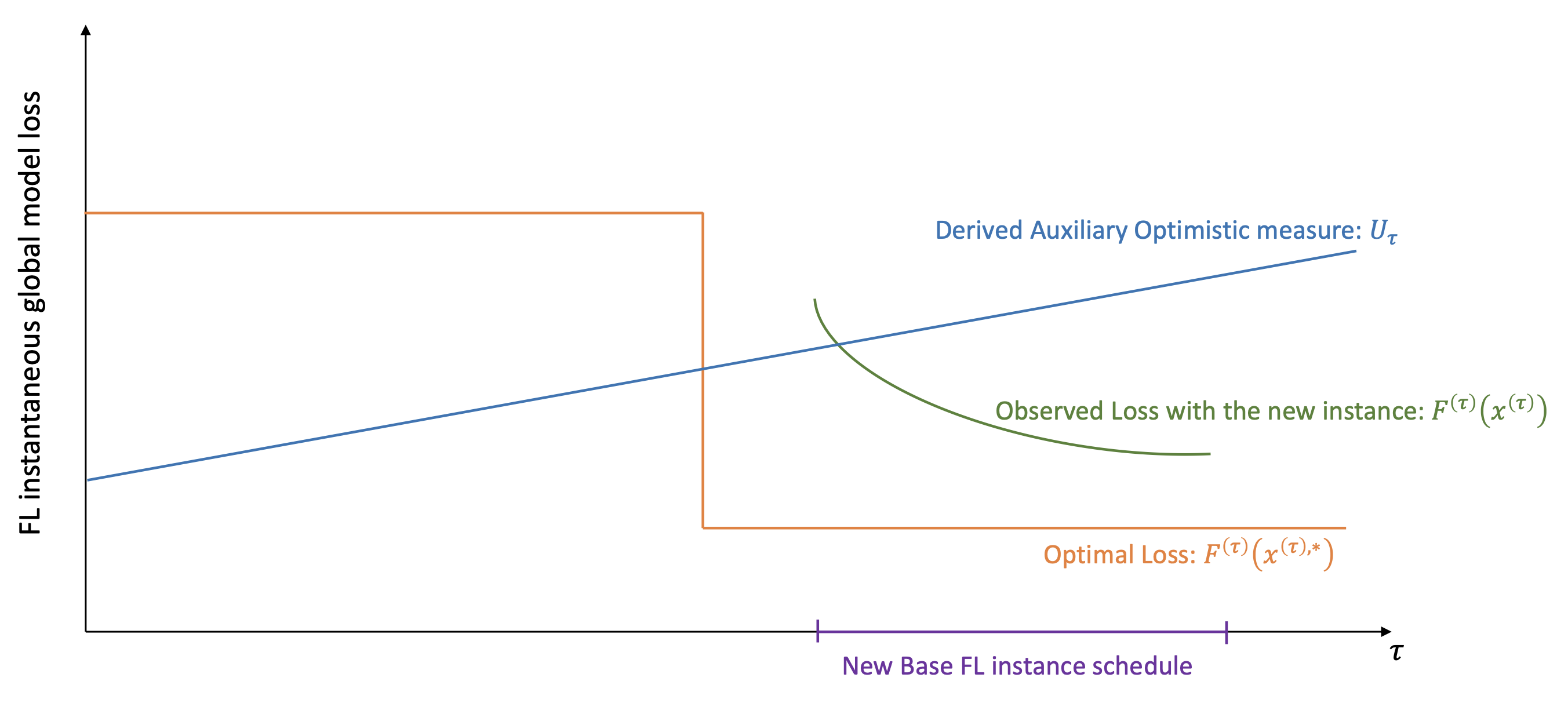
Train at different time scales. Look for change. Restart when needed. MASTER-FL coordinates short and long training runs, using their losses to test whether the environment has shifted. It works with established optimizers such as FedAvg and FedOMD.
03 / Does it help?
We tested 20 clients over 500 training rounds on two classification datasets, introducing new classes and swapping labels. In these experiments, both MASTER-FL variants achieved higher average accuracy than FedNova and FedProx.
Lower loss is better. Spikes reflect changes in the data. Follow the red and green MASTER-FL curves against the pink and yellow baselines.
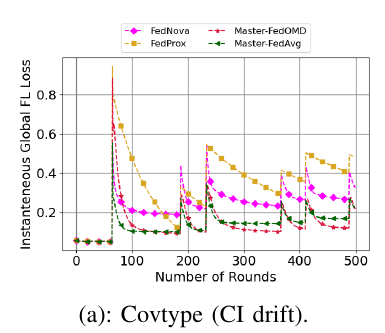
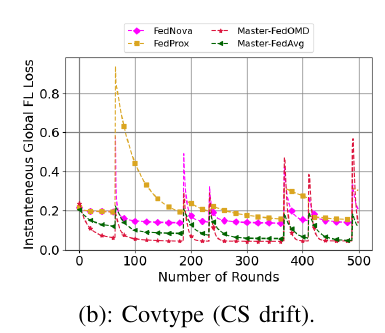
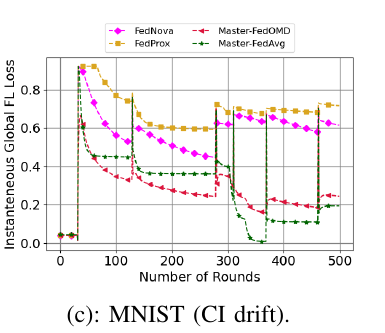
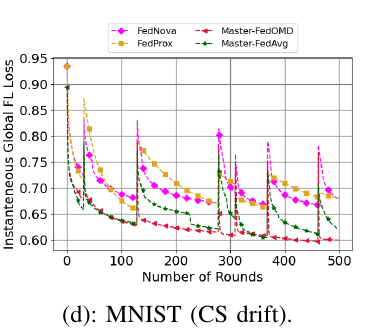
Select any figure to open its full-size view.
Average accuracy for MASTER-FL + FedOMD versus FedNova on MNIST with label swaps: 13.6 percentage points higher in this experiment. Source: Table II.
Why this work matters
It connects a practical question—when should a model adapt?—to an algorithm and a mathematical performance guarantee. The contribution spans distributed ML, change detection, and online optimization.
Scope: These are controlled experiments, not production results. The guarantees assume convex losses and depend on how much the environment changes; they do not automatically extend to arbitrary deep networks.
Technical context & sources
Joint work by Bhargav Ganguly and Vaneet Aggarwal. The analysis bounds dynamic regret: cumulative loss relative to the best model at each round. Sublinear regret requires sufficiently limited change, alongside the paper’s bounded, Lipschitz, convex-loss and base-optimizer assumptions.
The experiments do not report uncertainty intervals in Table II. Keeping raw data local is not itself a formal privacy guarantee; detailed privacy-preserving loss computation is left to future work.
Figures 1 and 3 were extracted from the supplied arXiv v2 manuscript (6 May 2023), pages 5 and 10. Figure 2 uses the existing illustration. See Sections III–IV, Theorem 3, and Section VI / Table II.